Lessons for Teaching the Ancient Americas:
Olmec, Maya, Aztec, and Inca
Although the Olmec, Maya, Aztec, and Inca are dated to exist at a later time, they are still considered part of the ancient world and are likely included with your ancient civilization curriculum.
It may be tempting to skip these societies when planning out your curriculum, since you may be short on time or more likely, short on resources.
Early on in my teaching career, I found the lack of resources to the biggest reason why I did little to cover these civilizations.
Even the current textbook includes only one brief chapter on the Maya and one small subsection on the Olmec.
And so I set out to research these civilizations and put together Lesson Sets to share with other teachers like you. In this post you’ll discover the lessons you should include with your ancient Americas unit.

Mesoamerica Civilizations
You often hear about the ancient civilizations in North and South America referred to as Mesoamerica.
Technically, the term Mesoamerica stems from the Greek language and translates to Middle America. Today, it refers to the historical region and cultural area in the southern parts of North America and most of Central America.
So, it makes sense to call it your Mesoamerica Unit if you are teaching about the Olmec, Maya, and Aztec.
But if you include the Inca, who are located on South America, then you’ll want to refer to your unit as the Ancient Americas.
Technically, the term Mesoamerica stems from the Greek language and translates to Middle America. Today, it refers to the historical region and cultural area in the southern parts of North America and most of Central America.
So, it makes sense to call it your Mesoamerica Unit if you are teaching about the Olmec, Maya, and Aztec.
But if you include the Inca, who are located on South America, then you’ll want to refer to your unit as the Ancient Americas.
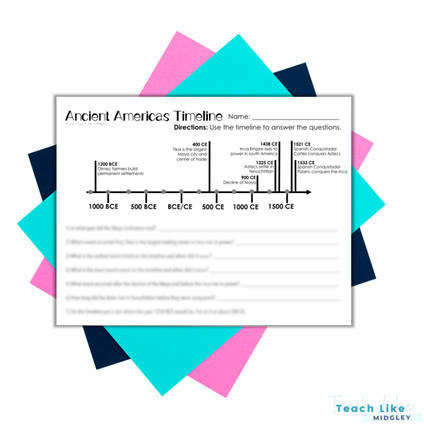
Ancient Americas Timeline Available in my TpT Store
Ancient Olmec
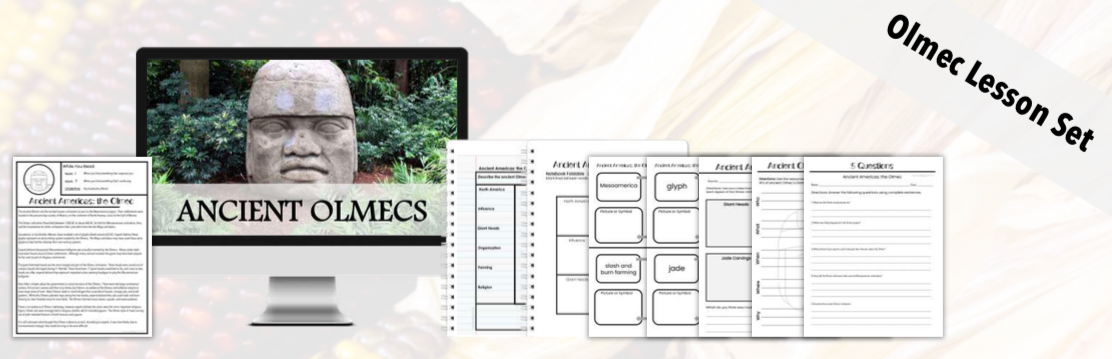
The ancient Olmec are the earliest known civilization in Mesoamerica, dating back to around 1500 BCE. Which makes it an ideal place to start, even though little is known about government and social structure of the civilization.
When developing the Lesson Set for the Olmecs, I had to dive into several different sources. Most textbooks and educational resources only make mention of the Olmec being the first, and of course, show pictures of the giant stone heads.
So far, 17 of these giant heads have been uncovered and each carving includes a helmet and a unique face.
But what makes the Olmec most significant of the ancient America civilizations, is that they began the foundations for the cultures that came after them.
The Maya and the Aztec borrowed ideas of language, religion, and even the rubber ballgame from the Olmec.
When developing the Lesson Set for the Olmecs, I had to dive into several different sources. Most textbooks and educational resources only make mention of the Olmec being the first, and of course, show pictures of the giant stone heads.
So far, 17 of these giant heads have been uncovered and each carving includes a helmet and a unique face.
But what makes the Olmec most significant of the ancient America civilizations, is that they began the foundations for the cultures that came after them.
The Maya and the Aztec borrowed ideas of language, religion, and even the rubber ballgame from the Olmec.
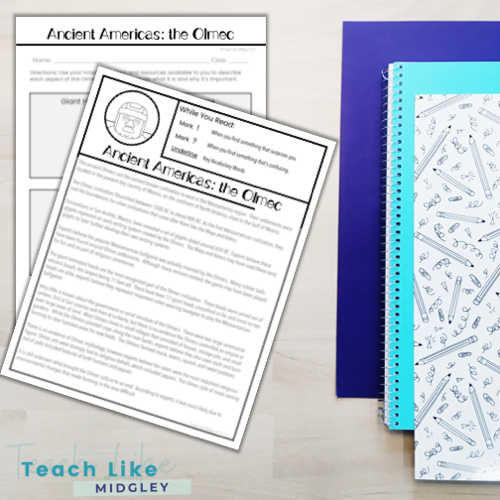
Part of the Ancient Olmec Lesson Set Available in my TpT Store
Ancient Maya
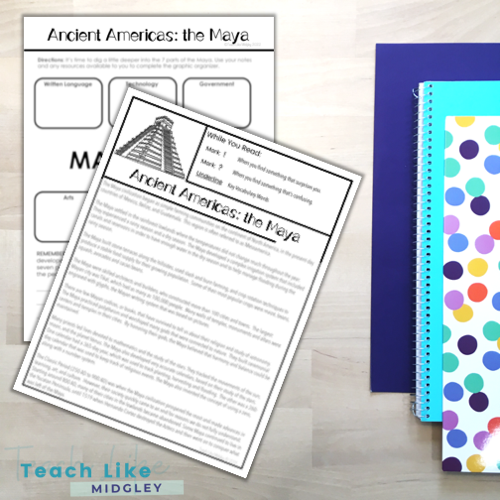
The first Maya cities developed around 750 BCE and many sites are still being uncovered today.
They developed an extensive written language system the consisted of hundreds of hieroglyphs. Many of the Maya codices were destroyed by the Spanish conquistadors.
The Maya are most known for their development of a 365 day calendar that is still used today and the pyramid temples that are still standing.
They developed an extensive written language system the consisted of hundreds of hieroglyphs. Many of the Maya codices were destroyed by the Spanish conquistadors.
The Maya are most known for their development of a 365 day calendar that is still used today and the pyramid temples that are still standing.
Part of the Ancient Maya Lesson Set Available in my TpT Store
Ancient Aztec
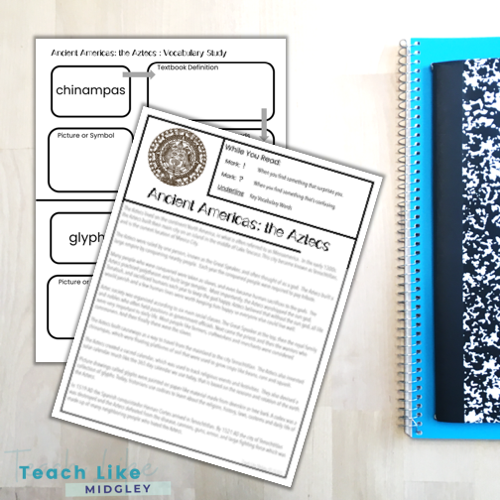
The Aztec civilization began around 1300 BCE and focused their culture around their religious beliefs.
The Aztecs are remembered for building pyramid temples and conquered neighboring people who they would sacrifice to their gods. It is believed the Aztecs made approximately 20,000 sacrifices (skinned, dismembered, decapitated, and hearts ripped out of living people).
Their capital, Tenochtitlan, was quite unique in having been built in the center of Lake Texcoco, which is actually where Mexico City stands today.
At the time, the Aztecs built causeways to access the city, and had a unique strategy for farming. They built chinampas which were like floating islands connected by ropes and filled with soil. The crops were planted in the soil.
The Aztecs are remembered for building pyramid temples and conquered neighboring people who they would sacrifice to their gods. It is believed the Aztecs made approximately 20,000 sacrifices (skinned, dismembered, decapitated, and hearts ripped out of living people).
Their capital, Tenochtitlan, was quite unique in having been built in the center of Lake Texcoco, which is actually where Mexico City stands today.
At the time, the Aztecs built causeways to access the city, and had a unique strategy for farming. They built chinampas which were like floating islands connected by ropes and filled with soil. The crops were planted in the soil.
Part of the Ancient Aztec Lesson Set Available in my TpT Store
Ancient Inca
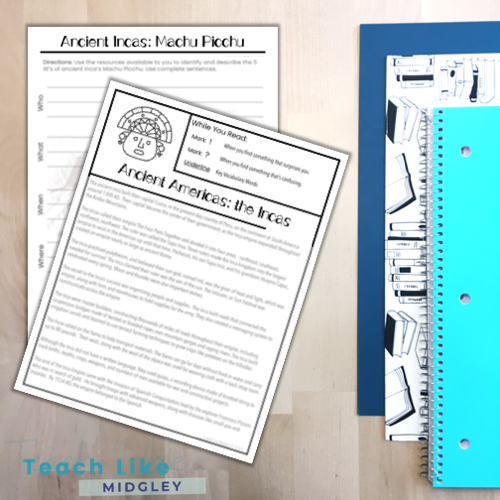
The Inca built the largest empire during ancient times, along the western coast of South America throughout the Andes Mountains.
The Inca are very unique because there are several features they did NOT have in comparison to other ancient civilizations.
The Inca traveled everywhere on foot, as they did not have the invention of the wheel, nor did they have horses to ride. The llama and alpaca were helpful in carrying goods, but can only carry up to 80 pounds.
Even though they only traveled by foot, the Inca created a large empire throughout the mountains with trails and rope bridges connecting each part of the empire, complete with a messenger system to communicate.
The Inca also lacked the use of iron or steel, which one might say put their tools at a disadvantage. Yet it did not stop them from building shelters, elaborate irrigation systems, and farming on hillsides.
The Inca are also the only ancient civilization to not have an official written language. They did, however, use knotted ropes called quipu for record keeping and communication.
The Inca are very unique because there are several features they did NOT have in comparison to other ancient civilizations.
The Inca traveled everywhere on foot, as they did not have the invention of the wheel, nor did they have horses to ride. The llama and alpaca were helpful in carrying goods, but can only carry up to 80 pounds.
Even though they only traveled by foot, the Inca created a large empire throughout the mountains with trails and rope bridges connecting each part of the empire, complete with a messenger system to communicate.
The Inca also lacked the use of iron or steel, which one might say put their tools at a disadvantage. Yet it did not stop them from building shelters, elaborate irrigation systems, and farming on hillsides.
The Inca are also the only ancient civilization to not have an official written language. They did, however, use knotted ropes called quipu for record keeping and communication.
Part of the Ancient Inca Lesson Set Available in my TpT Store
Developing Lesson Plans
The Olmec, Maya, Aztec, and Inca are all very interesting historical civilizations to share with your students. The architecture, art, people, and ancient cities left behind are very engaging while learning about the ancient civilizations of our history.
At the minimum, I would recommend you include at least one day for each of the four civilizations. Then leave a fifth day to do some compare and contrast.
But if you have a little more time, then you may want to consider a fun comprehensive project to engage your students!
In my own classroom, I use the ancient America civilizations to challenge my students during fourth quarter after we have finished ancient Rome.
If you’ve been around the blog for a while, then you are likely familiar with the 7 Part Structure I use to teach students. Each year I challenge my students to identify the 7 parts for each of the ancient America civilizations. This is my favorite way to gear up my students for their final Ancient Civilization Simulation Project at the end of the school year.
At the minimum, I would recommend you include at least one day for each of the four civilizations. Then leave a fifth day to do some compare and contrast.
But if you have a little more time, then you may want to consider a fun comprehensive project to engage your students!
In my own classroom, I use the ancient America civilizations to challenge my students during fourth quarter after we have finished ancient Rome.
If you’ve been around the blog for a while, then you are likely familiar with the 7 Part Structure I use to teach students. Each year I challenge my students to identify the 7 parts for each of the ancient America civilizations. This is my favorite way to gear up my students for their final Ancient Civilization Simulation Project at the end of the school year.
Ready to Roll Materials...
Now that you know the ancient America civilizations are indeed worth your time to include in your plans, you are ready to dazzle your students!
But as mentioned before, I know that the most challenging part of teaching these civilizations is the lack of resources out there to do it. And so, I’m excited to share with you some done-for-you resources! Complete Lesson Sets for the Olmec, Maya, Aztec and Inca which you can snag in the money saving Bundle too!
Also, if you are in need of a fun way to challenge your students at the end of the year, then you’ll want to check out the End of the Year Challenge Pack!
But as mentioned before, I know that the most challenging part of teaching these civilizations is the lack of resources out there to do it. And so, I’m excited to share with you some done-for-you resources! Complete Lesson Sets for the Olmec, Maya, Aztec and Inca which you can snag in the money saving Bundle too!
Also, if you are in need of a fun way to challenge your students at the end of the year, then you’ll want to check out the End of the Year Challenge Pack!
Each Lesson Set Includes Multiple Options to Meet Student Needs!
You May Also Like...
Let's Connect...

Welcome! I'm Hillary Midgley, a veteran 6th grade teacher.
I create educational materials and develop curriculum for other teachers. I specialize in teaching students how to learn through my Study Skills Curriculum. I have established fundamental classroom systems and structures for teachers to help them streamline their classroom. And my passion is teaching ancient history through engaging activities with foundations in academic skills. Here you will find resources on all of these topics and more. Learn more about me here.

|

|

|

|